
Leadership Myth Exposed
“If you fix the visible problem, you’ve solved the issue”
In leadership, the problem you see, may not be the real problem that needs solving.
The Problem Wasn’t Delegation
Frank was recently promoted into a new role with a new team. He was convinced his biggest challenge was delegation.
When we first started working together, he told me:
“I’m overwhelmed. I’m working night and weekends, and my team relies on me for everything. I know I need to delegate more.”
Frank wanted help developing delegation skills. But he was a pretty senior guy. I wasn’t so sure delegation was his real problem.
I asked him questions about what kept him from delegating and a few barriers started to emerge. Every time he delegated, he would redo the work before it went out. He wanted his fingerprints on it.
The real problem? He didn’t fully trust his team.
Added to that, he hadn’t put in the time to get to know and develop his new team.
Instead of investing time in development that would yield long-term results, he went into quick fix mode and just did the work himself.
Another factor? He wanted to impress his new boss. And he thought the best and fastest way to do that would be to do the work himself.
It wasn’t.
This kind of behavior was detrimental to him as a leader, to his team, and to the work itself.
Why We Don’t Slow Down to Understand the Problem
This can happen to the best of us. We lock in on what we think is the immediate problem. But what we don’t take the time to truly understand is the problem itself before we rush in to identify a solution.
Why?
Because as leaders, you’re under increasing pressure with less time and extremely high demands. These factors can all prohibit us from slowing down just a bit to get to the root causes of the biggest and most complex problems we’re trying to solve.
Now, of course, we can swing in the other direction and be paralyzed thinking if we just went a little bit deeper and had a little bit more time, we’d find the perfect solution.
We don’t want to do that either.
Sometimes the best solution takes a bit longer to uncover. And the only way to get to that best solution is to truly understand the actual problem.
Let’s look at it from a different view
Have you ever tried to solve a problem only to see it reappear?
Have you ever felt like you’re rushing to fix a problem, but you somehow know that there’s something more that needs to be addressed?
What’s really going on here?
Surface Issues vs. Root Causes
The myth is that if you fix the visible problem, you’ve solved the issue.
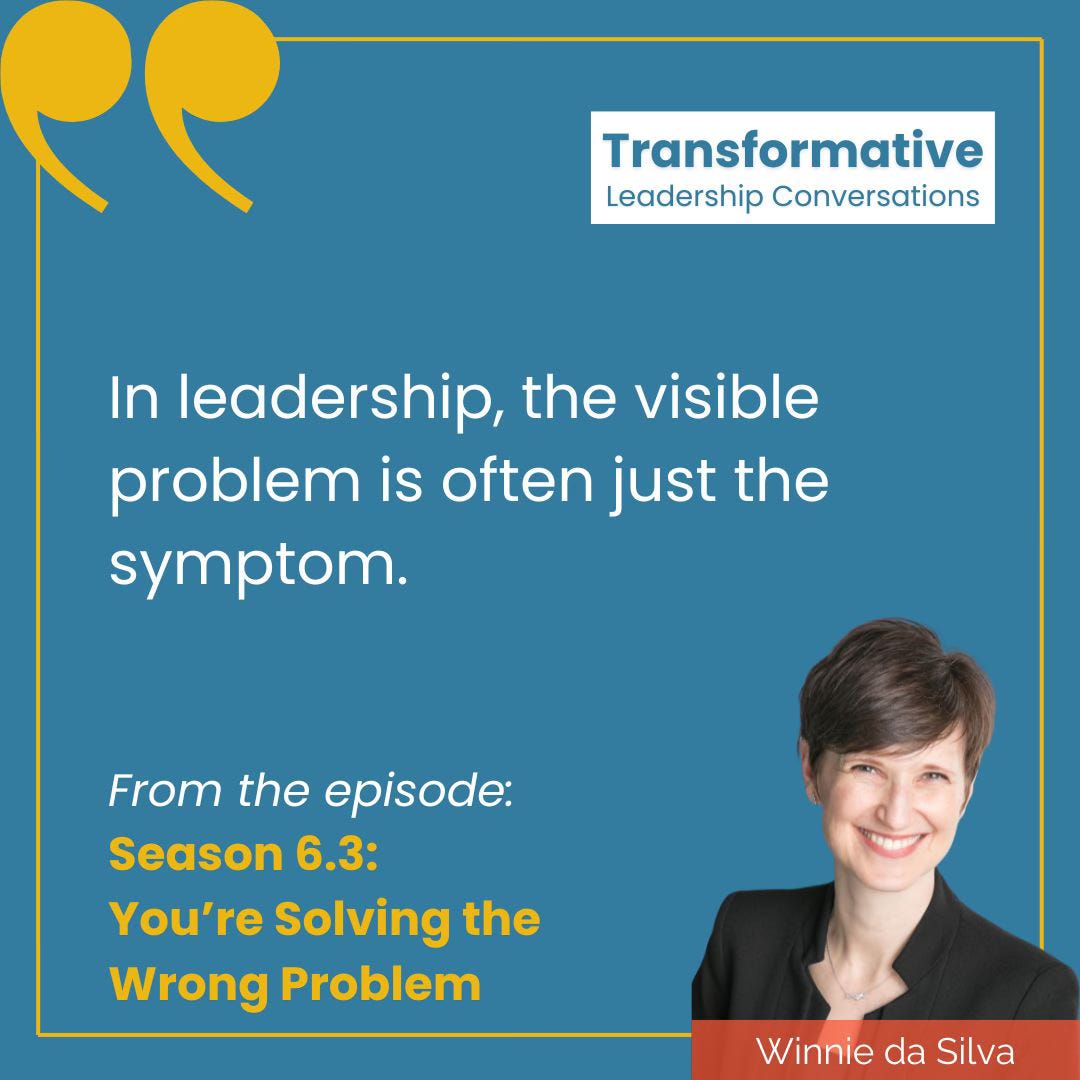
But in leadership, the visible problem is often just the symptom. The real driver is usually something underneath it.
I often think about this as the difference between surface issues and root causes.
The surface issue is the behavior or event you can see. Missed deadlines, lack of accountability, slow decisions, poor communication.
The root cause is the underlying dynamic that’s creating that behavior.
When leaders slow down long enough to look deeper, the real issue often turns out to be something like unclear expectations, misaligned incentives, conversations that are being avoided, cultural norms that aren’t working, or leadership blind spots.
Solving symptoms sometimes create temporary relief. Addressing root causes creates sustainable change.
This is not about overcomplicating problems. It’s about identifying and solving the real problem.
A few years ago, I worked with a large team within a highly complex matrixed organization. The problem they thought they had was this: our process for making decisions as a team is too slow.
But after doing some work with this team, including conducting an in-depth team assessment, we realized that the leaders two levels above them were constantly sending mixed messages.
This team was not getting clear mandates from above. This was the core problem that needed to be addressed.
Once we were able to navigate mixed messages from the top, decision-making was much clearer and timelier.
Why does this myth feel so enticing?
Speed feels productive.
Uncovering root causes feels slow.
Most businesses live for short-term results.
Deeper problems often point to issues with other people.
There is an emotional toll to solving complex problems.
How to Find the Real Problem
In the end, it feels easier to adjust a process than to examine the root cause, which might include our own behavior.
So let’s talk about a few ways to check if there is a deeper problem.
Pause. Think.
Before jumping into a solution, ask yourself a few questions.
What else could be driving this?
Where else does this pattern show up?
How might I be contributing to this problem?
What incentives or behaviors are reinforcing it?
Collect some data.
Ask a colleague. Ask your team. Find a few smart people you trust and use them as a sounding board. Do some research.
Pause again.
Think about the data you’ve collected. Think about what you’ve learned. Make a decision. Pilot something. Learn. Iterate. Keep going.
Solving the Right Problem Changes Everything
Getting to the root cause of a problem often prevents future problems.
Solving the right problem changes everything.
Not every problem deserves a complete uncovering.
Focus on this: upgrading your leadership habits to pause, think, ask good questions, gather data, and experiment.
This is where you will truly uncover sustainable solutions to seemingly intractable problems.
Next up…
Episode 4: Why Leadership Development Fails
I work with leaders who are serious about growth and who want to see real personal, professional, and business results. If you’re ready to take your leadership to the next level or empower your teams for success, I’m here to help.
Reach out to me directly at winnie@winnifred.org or check out my website at www.winniedasilva.com to learn more about my work in coaching executives, developing critical leadership skills, and working with clients to build effective team. In addition to finding me here on Substack, you can also find me on LinkedIn and YouTube.